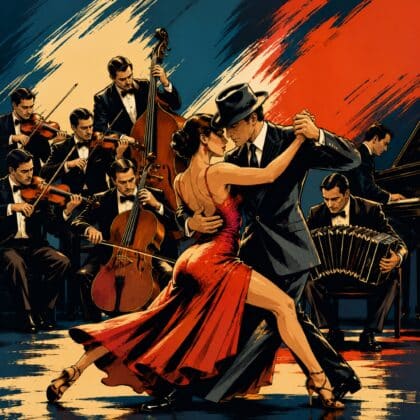
One singer introduced the genre to the rest of the world and gave a face to its melancholic lyrics. His records sold in the millions, while his dramatic death in the 1930s sparked a wave of grief. To this day, fans can still hear his songs on the streets of Buenos Aires. His voice set the standard for subsequent generations of vocalists. We ask you: Who is still considered the immortal voice of Argentine tango worldwide?
Musically, the dance thrives on intense emotions and sudden changes in tempo. Some composers relied on lively melodies to engage the audience, while others preferred heavy accents and jarring dissonances. One orchestra leader stood out for his driven, uncompromising style. His compositions created a sombre atmosphere on the dance floors. Which Argentine musician and arranger redefined the emotional and rhythmic boundaries of tango?
At nearly every tango dance ball around the world, a particular tango classic is played as the final dance of the evening. Many listeners automatically associate this piece with the capital, Buenos Aires, but its historical roots lie beyond the country’s borders, on the banks of the Río de la Plata. A student originally composed the melody as a marching song for a local carnival parade. It was only through later arrangements that the piece became a global anthem. In which of Argentina’s neighbouring countries was “La Cumparsita” written in 1917?